
Monday

some key words...
Representation - how something is Re presented. Re: Again
regional identity - the identity of a setting
Verisimilitude - the appearance of being true or real. Most TV shows will use a lot of realism to add to their verisimilitude.
regional identity - the identity of a setting
Verisimilitude - the appearance of being true or real. Most TV shows will use a lot of realism to add to their verisimilitude.
Mise-en-scene: Sound
Sound
Types of music i would expect to see with these types of genres:
- Action - fast paced music
- Horror - High or low pitched or no music = to create an eery feeling.
- Sci - Fi: computerised music
- Comedy: up beat music
- Romance: Calm, nice, classic music
- Children's films: Light and happy
- Fantasy: mystical and dramatic music.
Diegetic sound
Diegetic sounds are noises that would appear naturally in the scene, for example, if a character was singing, this would be diegetic music.
Non - Diegetic sound
Non - Diegetic sounds are noises that wouldn't appear naturally in the scene, for example a narrator would be a non- diegetic sound.
applying narrative theories to my terror in the night task
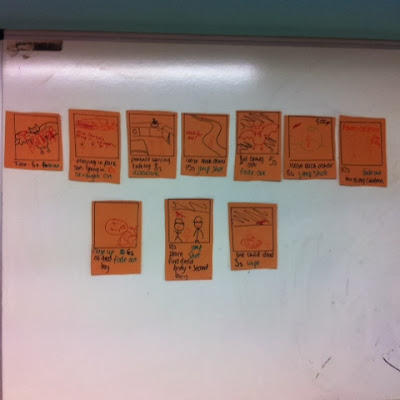
My storyboard for "Terror in the night" has a linear structure, as it opens with a scene showing the bat, and then showing the two children playing in the park, followed by a scene conveying the parents - thus introducing us to the characters and the story. It then continues to a scene where the children are running from the bat, and the parents are phoning the police; the story builds. It then ends with one of the children dying, the police finding both children, and then a long shot of the dead child with the bat in the background. Therefore meaning my storyboard has a linear structure.
My storyboard links to Barthes ideas on narrative structure, as it has aspects of the action code in it, for example, the audience know that the children are in a park, because the mise en scene indicates this.
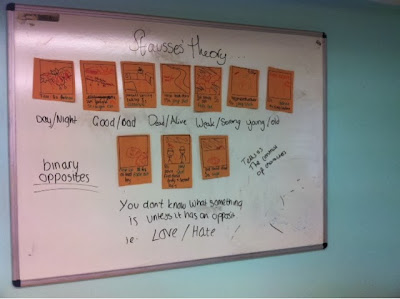
My storyboard links to Strausse's theory, as it conveys binary opposites such as light/dark alive/dead strong/weak evil/good young/old included in it. Strausse's theory suggests that nothing is known without its opposite, meaning that we would not understand what one thing is, without the other. e.g. without day, we would not understand what night was.
Friday
Levi - Strauss

Levi- Strauss describes narrative as being created by binary opposites.
Meaning that he believed there was no meaning without binary opposites, how do you know what cold is, if there's no such thing as hot? He was a structuralist, believing that we don't make an interpretation, and meaning is only created by knowing what it is not.

Hitchcocks structure 1960
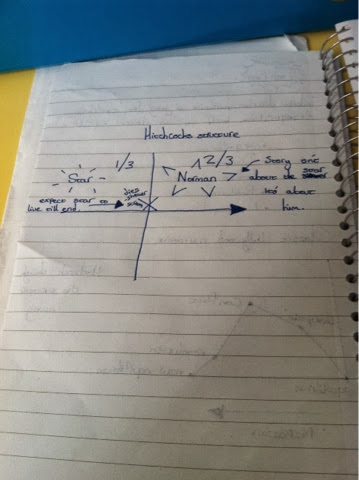 Hitchcocks structure shocked audiences of its time, as it was so different from what the audience expected, this is because they had not experienced anything like this at the time, and, overall in horror films the 'star' of the film would survive whatever horror they had to face, where as in Hitchcocks film "Psycho" the star is killed off after the audience has identified with her, shocking the audience.This was so different to what had been done at the time, that it made the film infamous, and this example added to my inference that narrative structure can by moved around and edited to portray a different meaning, and change the way the story is told.
Todorov

Todorov describes narrative as going from a state of balance (equilibrium) back to an altered equilibrium.
- equilibrium
- disruption
- conflict
- resoulution
- new equilibrium
This is the classic Hollywood narrative.

Subscribe to:
Posts (Atom)